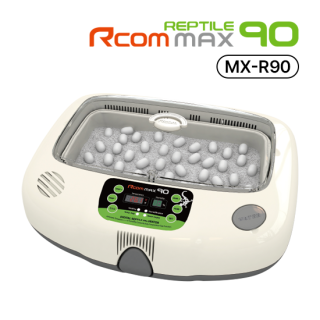
The Rcom Juragon MX90R Reptile Egg Incubator Hatcher is designed for high-performance reptile incubation for breeders, conservation programs, and herpetology labs. Built with advanced digital control technology, the MX90R helps maintain stable temperature and humidity conditions, which are essential for healthy embryonic development and reliable hatching.
Whether you are working with a small clutch or a larger breeding program, this incubator offers flexibility, capacity, and dependable performance. The intuitive LCD interface, precision sensors, and built-in safety features make it a practical tool for reptile keepers and professionals focused on successful hatch cycles.
Key Features:
- Advanced temperature and humidity control for stable incubation conditions
- Temperature range: 20°C-42°C / 68°F-107.6°F
- Humidity range: 40-90%, adjusted manually using heat, substrate moisture, and ventilation
- Large internal capacity for approximately 10-120 reptile eggs, depending on egg size and species
- User-friendly LCD display for monitoring temperature, humidity, and settings
- Built-in safety features, including overheat protection, steady airflow, and secure housing
Technical Specifications:
- Temperature range: 20°C-42°C / 68°F-107.6°F
- Humidity range: 40-90%
- Net weight: 4.35 kg / 9.6 lb
- Gross weight: 5.35 kg / 11.7 lb
- Dimensions: 63.3 W x 52.3 L x 17.1 H cm
- Power requirement: 110-120V, 60Hz
- Energy consumption: average 48W / maximum 68W
Package Includes:
- Rcom Juragon MX90R reptile incubator
- Internal egg tray
- Power cord
- Printed instruction manual
Additional Notes:
The Rcom MX90R is suitable for controlled laboratory, educational, or home breeding environments. While it provides advanced temperature control, humidity should be managed manually according to substrate moisture, ventilation, and room conditions. This incubator is not intended for outdoor or uncontrolled environments.
Suitable for eggs from geckos, turtles, lizards, snakes, and other exotic reptiles. Proper calibration, regular observation, and species-specific incubation settings are recommended for successful hatch cycles.